
 Back to Insights
 09 Jan, 2026
 SPRG Guangzhou
B2B companies are facing unprecedented customer acquisition challenges in today’s wave of digital transformation.
While traditional search engine optimisation (SEO) remains a stable source of traffic, growth has clearly begun to plateau, and in some cases, decline. In contrast, AI-driven generative engine optimisation (GEO) is rising rapidly, creating what many marketers see as a new blue ocean for B2B growth. Strategic DigitaLab (SDL) has found that companies that move early on GEO are already seeing notable improvements in customer acquisition costs.
01 A Quiet but Massive “Traffic Migration”
The rapid rise of AI search is quietly rewriting the rules of B2B customer acquisition. Relying on traditional methods alone is no longer enough. In the AI era, real growth comes from combining SEO and GEO as dual engines, amplified by social media optimisation (SMO).
And the shift is already happening at scale. Imagine this: every day in China, more than 650 million people are no longer just “Baidu‑ing” things. Instead, they’re turning to AI search tools like Doubao and ERNIE Bot to ask direct questions such as: “Which CRM system is best for SMEs?”
At the same time, millions of B2B decision‑makers are browsing industry case studies and joining professional discussions across social platforms.
In other words, a “full‑funnel traffic migration” is already underway.
Before we go deeper, let’s break down two core concepts in simple terms:
1. SEO
This is the traditional search engine optimisation we’re used to seeing on platforms like Baidu and Sogou. For example, when someone searches “industrial equipment supplier” and your company ranks near the top, that’s down to SEO.
2. GEO
In a nutshell, GEO is optimisation for generative AI search tools like Doubao and ERNIE Bot. As more people get used to asking AI directly for answers instead of sifting through multiple web pages, GEO helps ensure your company appears within those AI‑generated responses so potential customers can actually see you.
Over the past two years, the gap between SEO and GEO has widened significantly.
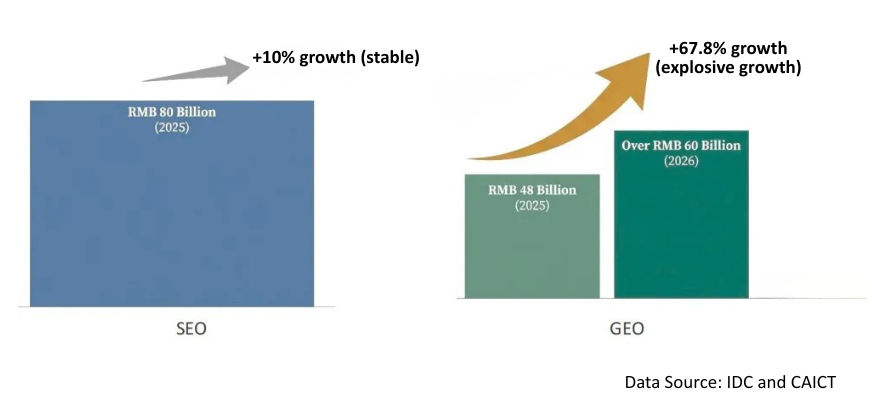
Traditional SEO remains a stable and important foundation, with a global market worth around USD 8 billion and roughly RMB 9 billion in China. But growth has slowed significantly, slumping to about 5–8%. GEO, on the other hand, is in a phase of explosive growth. In China alone, the market was projected to reach RMB 48 billion in 2025, with a growth rate of 67.8%, far outpacing traditional SEO.
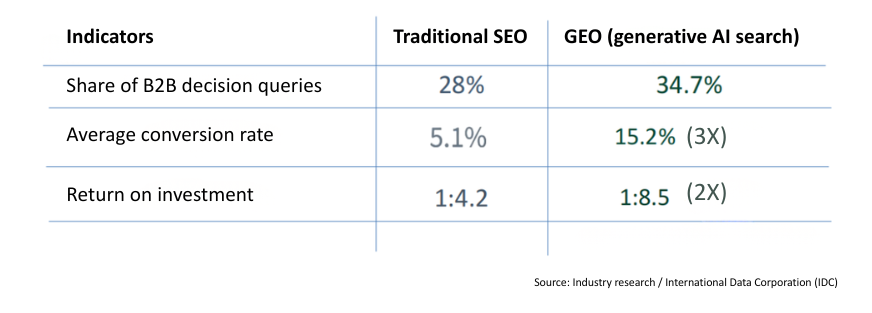
Even more importantly for B2B companies, GEO is showing much better “earning power”. For every 1 unit invested in SEO, you might generate around 4.2 units in revenue, with a conversion rate of 5.1%. With GEO, that same 1 unit of investment can potentially generate 8.5 units, with conversion rates as high as 15.2%—roughly three times higher.
02 Why Is GEO So Powerful?
So why is GEO performing so well? The short answer: because it captures users with clear intent.
If traditional search is like casting a wide fishing net into the ocean, AI search is more like precision angling. When B2B buyers are looking for suppliers, they usually have very specific needs. Data shows that 34.2% of GEO queries are commercial decision-making questions like:
“Which supplier should I choose?”
“Which solution is better?”
By comparison, these high‑value questions account for only 27.8% of SEO queries.
In other words, a customer asking AI: “Which ERP providers are reliable in 2026?” is likely to see a very different set of results compared with someone simply searching Baidu for: “Reliable ERP service 2026”.
And more importantly, the conversion outcomes are often very different too.
SDL has found that companies adopting GEO early have already reduced their customer acquisition costs by around 40–70%. Those combining GEO with SMO are seeing even stronger results – not only lowering acquisition costs by 40–70%, but also shortening sales cycles by 33%. In these scenarios, GEO’s precision targeting makes it more than twice as efficient as traditional channels when it comes to reaching the right prospects.
03 A New Growth Playbook: SEO + GEO for Precision, SMO for Reach
At this point, some might ask: does this mean SEO can be taken off the table? The answer is no.
 Although SEO is growing more slowly, it still “protects the core”. If your customers are looking for you, they can quickly find your company by searching your brand name or key products. Strong rankings for core industry keywords still play an important role in maintaining brand visibility. GEO, on the other hand, is better suited to “opening up new fronts” – especially when it comes to capturing incremental customers who are already used to searching via AI.
This is where SMO—social media optimisation—comes in, forming a complementary trio alongside SEO and GEO. SEO targets traditional search engines, GEO focuses on generative AI search, and SMO is all about traffic and user engagement on social platforms. As mentioned earlier, if AI search is like precision angling, then social media is the “trust pond”. When B2B buyers look for suppliers, they typically have clear needs, but before making a decision, they often turn to social channels to validate a brand’s reputation.
That’s why SDL recommends companies adopt a “three‑engine synergy” strategy:
• SEO to strengthen the existing foundation
Focus on maintaining rankings for your brand and core product keywords, defending your position in existing markets, and ensuring competitors don’t erode your visibility over time.
• GEO to unlock incremental growth
Use structured content such as white papers and solution comparison guides to secure recommendations in AI‑generated answers.
• SMO to build trust
Leverage social media engagement to reinforce both SEO and GEO, reducing the trust barrier in customer decision‑making.
A good example comes from an industrial manufacturing company. By sharing a case study focused on achieving “30% cost reduction in manufacturing” on LinkedIn (SMO), the company attracted over 500 highly targeted followers. That same content was then indexed by Baidu, helping improve its ranking for the keyword “manufacturing cost‑reduction solutions” (SEO). At the same time, ERNIE Bot referenced the case study when responding to the query: “Recommended suppliers for manufacturing cost reduction” (GEO).
In the end, leads generated from this single piece of content achieved a conversion rate of 18.7%, far higher than any single channel could have delivered alone.
04 Action Guide: Three Steps to Capture the New Wave of Growth
• Content strategy
Build a “create once, adapt everywhere” content system. Core assets such as industry white papers and solution guides should be repurposed into multiple formats tailored for different channels:
• Keyword‑optimised articles for SEO
• Structured Q&A content for GEO
• Short videos, live streams and bite‑sized summaries for SMO
Each platform should play to its strengths. For example, LinkedIn content can focus on data insights, Douyin on visualising case studies, and WeChat official accounts on in‑depth analysis.
At the same time, SMO can be used to collect frequently asked customer questions, which can then be fed back into SEO and GEO content optimisation.
• Account alignment
Standardise your brand presence across platforms – from profile pictures and account names to tone of voice and messaging. Core keywords and conversion pathways (website links, private domain QR codes) should be embedded into SMO bios so that high‑quality social content can be quickly identified by both search engines and AI systems.
• Performance tracking
In addition to traditional traffic metrics, companies should establish GEO- and SMO-specific KPIs, such as:
• “Answer citation rate” for GEO
• Private‑domain lead‑in rate for SMO
Connect your data flows so you can track the full customer journey from social exposure, to search queries, through to enquiry and conversion, and adjust budget allocation dynamically.
It’s worth noting that you don’t need to roll out the three‑engine approach all at once. A more practical approach is to start small—for example, by optimising your social media accounts and publishing 3–5 pieces of industry-focused content—then, from there, SEO and GEO strategies can gradually be layered in over time, allowing companies to test, learn, and control experimentation costs more effectively.
05 The Future is Already Here: High-Value B2B Customers Moving Into the AI Ecosystem
It is increasingly clear that AI search is becoming a core tool for B2B decision‑makers when screening and selecting suppliers. And in the AI era, the logic of customer acquisition is changing: it’s no longer about chasing customers across every possible channel. Instead, success comes from ensuring they see you repeatedly at different touchpoints, come to trust you, and ultimately approach you proactively. The AI search traffic dividend is only just beginning.
For B2B companies, capturing the strategic opportunity created by AI search means positioning themselves early around high‑value decision-making traffic. Rather than competing endlessly within a single channel, it is far more effective to leverage SDL’s digital marketing framework to build a full‑funnel presence across the AI ecosystem and open up new spaces for growth.
* All data in this article is drawn from the latest reports (November 2025 to January 2026) published by the International Data Corporation (IDC), the China Academy of Information and Communications Technology (CAICT), QuestMobile and other authoritative institutions.